The True King’s Eternal Kingdom (Part 1)
Preacher: Rev. James Pavlic Series: Daniel: Living in the Reality of Christ's Reign Scripture: Daniel 2:24–49
Daniel 2:24-49 - The True King’s Eternal Kingdom (Part 1)
A researcher at one of the leading companies developing AI, just quit last Tuesday. After spending the last three years doing AI research at both OpenAI and Anthropic, he posted: “Neither company is acting responsibly. They are racing straight to self-improving superintelligence and gambling with our lives. …These will soon be superhuman systems that can hack anything, revolutionize any field overnight, and acquire real power and resources.”
I don’t know whether he is right, but when we hear about things like this, what do we do? Maybe we ignore it, saying, “That won’t happen.” Maybe we fear it, thinking, “How can I keep myself safe?” Or maybe we become an activist, “I must help to stop this!”
But do you know what all three of these responses have in common? We can't ultimately control what is happening in the kingdoms of the world.
The Jews living in exile in Babylon and those living under foreign control after this likely felt one of these responses. Just like us, they were living in an earthly kingdom they couldn't control, with a king that they couldn’t control, unsure when God’s kingdom would come.
And in Daniel 2, Nebuchadnezzar is also at a loss. He has had a dream that troubles him so deeply that he orders Arioch to kill the wise men of Babylon because they can't tell him the dream and its interpretation.
But when Arioch knocks on Daniel’s door, Daniel doesn't panic, hide, or start a rebellion. He gathers his friends, and they pray. And in answer to that prayer, God reveals the mystery to Daniel in a vision in the night.
What is the dream and interpretation? Mighty kingdoms rising, falling, being crushed, becoming like chaff, and being blown away. Any one of these kingdoms would make someone think, “What is going to happen to us?” But God shows Daniel and Nebuchadnezzar their ultimate end.
When we face the rise of mighty kingdoms, what if, rather than sticking our heads in the ground, being paralyzed by fear, or being consumed with trying to regain control, we could face a rapidly changing world with confidence because we knew who actually controls the future?
With this in mind, let's listen closely to God's Word from Daniel 2:36-49.
Daniel 2:36–49 ESV
36 “This was the dream. Now we will tell the king its interpretation. 37 You, O king, the king of kings, to whom the God of heaven has given the kingdom, the power, and the might, and the glory, 38 and into whose hand he has given, wherever they dwell, the children of man, the beasts of the field, and the birds of the heavens, making you rule over them all—you are the head of gold. 39 Another kingdom inferior to you shall arise after you, and yet a third kingdom of bronze, which shall rule over all the earth. 40 And there shall be a fourth kingdom, strong as iron, because iron breaks to pieces and shatters all things. And like iron that crushes, it shall break and crush all these. 41 And as you saw the feet and toes, partly of potter’s clay and partly of iron, it shall be a divided kingdom, but some of the firmness of iron shall be in it, just as you saw iron mixed with the soft clay. 42 And as the toes of the feet were partly iron and partly clay, so the kingdom shall be partly strong and partly brittle. 43 As you saw the iron mixed with soft clay, so they will mix with one another in marriage, but they will not hold together, just as iron does not mix with clay. 44 And in the days of those kings the God of heaven will set up a kingdom that shall never be destroyed, nor shall the kingdom be left to another people. It shall break in pieces all these kingdoms and bring them to an end, and it shall stand forever, 45 just as you saw that a stone was cut from a mountain by no human hand, and that it broke in pieces the iron, the bronze, the clay, the silver, and the gold. A great God has made known to the king what shall be after this. The dream is certain, and its interpretation sure.” 46 Then King Nebuchadnezzar fell upon his face and paid homage to Daniel, and commanded that an offering and incense be offered up to him. 47 The king answered and said to Daniel, “Truly, your God is God of gods and Lord of kings, and a revealer of mysteries, for you have been able to reveal this mystery.” 48 Then the king gave Daniel high honors and many great gifts, and made him ruler over the whole province of Babylon and chief prefect over all the wise men of Babylon. 49 Daniel made a request of the king, and he appointed Shadrach, Meshach, and Abednego over the affairs of the province of Babylon. But Daniel remained at the king’s court.
We don't have to live in fear of whatever kingdom may arise. Why? No machine is all-encompassing and eternal. They will all turn to dust. And we know that…
Only God’s kingdom is all-encompassing and eternal
Do you remember your first electronic device? Mine was an Atari 2600 in the mid-80s. Where is it now? Just like everything else in this world, it is either broken, lost, rusted, thrown away, or turned into dust. And now, with the age of AI upon us, no one can predict with any certainty what will happen next. Why? You and I aren’t eternal, nor are we in control.
In verses 27-28, 45 we see that only God can reveal mysteries. Instead of Daniel taking the credit for being able to reveal the dream and interpretation, he says that nobody but the God in heaven can reveal mysteries. It is only God who knows what the future holds. Why? Because God knows and can give dreams because he is all-knowing. And he also is all-powerful “changing times and seasons, and removing kings and setting them up.” He can reveal mysteries because the future is in his hands.
In verses 34-35, it is made clear that only God's kingdom is all-encompassing. The dream revealed a stone which was cut by a non-human hand. This stone didn’t just crush the last kingdom, but any remnants of the other kingdoms were pulverized into chaff (waste from harvesting wheat) and blown away by the wind. The dominion and pride of these empires disappear like chaff, but God's kingdom remains, growing into a mountain that fills the whole earth and ultimately gathering a people from every tribe, tongue, and nation.
In verses 37-38, and 44-45, we are shown that only God's kingdom is eternal. As Daniel related to Nebuchadnezzar that his kingship and kingdom were given to him by the God of heaven and his power, might, and glory, essentially his dominion, were also given to him, it is clear that the kingdoms of the world are temporary and under God’s control. Since God sets up kingdoms, giving them power, might, and glory, he can also tear them down. Though every kingdom of this world will be destroyed, God’s eternal kingdom will be set up by the eternal God which will stand forever. The great God is the only one who can establish an unending kingdom, because he himself is the eternal God.
This should bring us comfort when we think about the terrifying kingdoms of the world. But even though history and the Bible teach us that every kingdom, and even ourselves are temporary and limited...
We seek to build and preserve our own temporary kingdoms
Why is there such a race to build a kingdom of AI supremacy? Is it progress? Preservation? Control? Safety? Wealth? Power? Quality of life? Excitement of potential? I think at bottom humanity, whether individually or collectively, seeks to build and preserve their own kingdoms, even though they are temporary.
In verses 24-26, we get a picture of how humanity seeks to build and preserve their kingdoms. If we remember from last week, Nebuchadnezzar commanded the death of the wise men because of his troubled spirit and their lack of ability to tell him both his dream and the interpretation of it. He likely was afraid that this dream was an omen about his kingdom. Nebuchadnezzar was seeking to preserve his kingdom at any cost, even human lives! But then, we notice that Arioch tells Nebuchadnezzar that he found Daniel among the exiles who could help with the king's dream and its interpretation. Now, we can’t know for certain, but it is possible that he may have been promoting his own self-interests, profiting from Daniel’s revelation. Whether this is true or not, it wouldn’t be hard to believe, because like them, we fight to build our kingdom through pride or preserve our kingdoms through self-centered use of power.
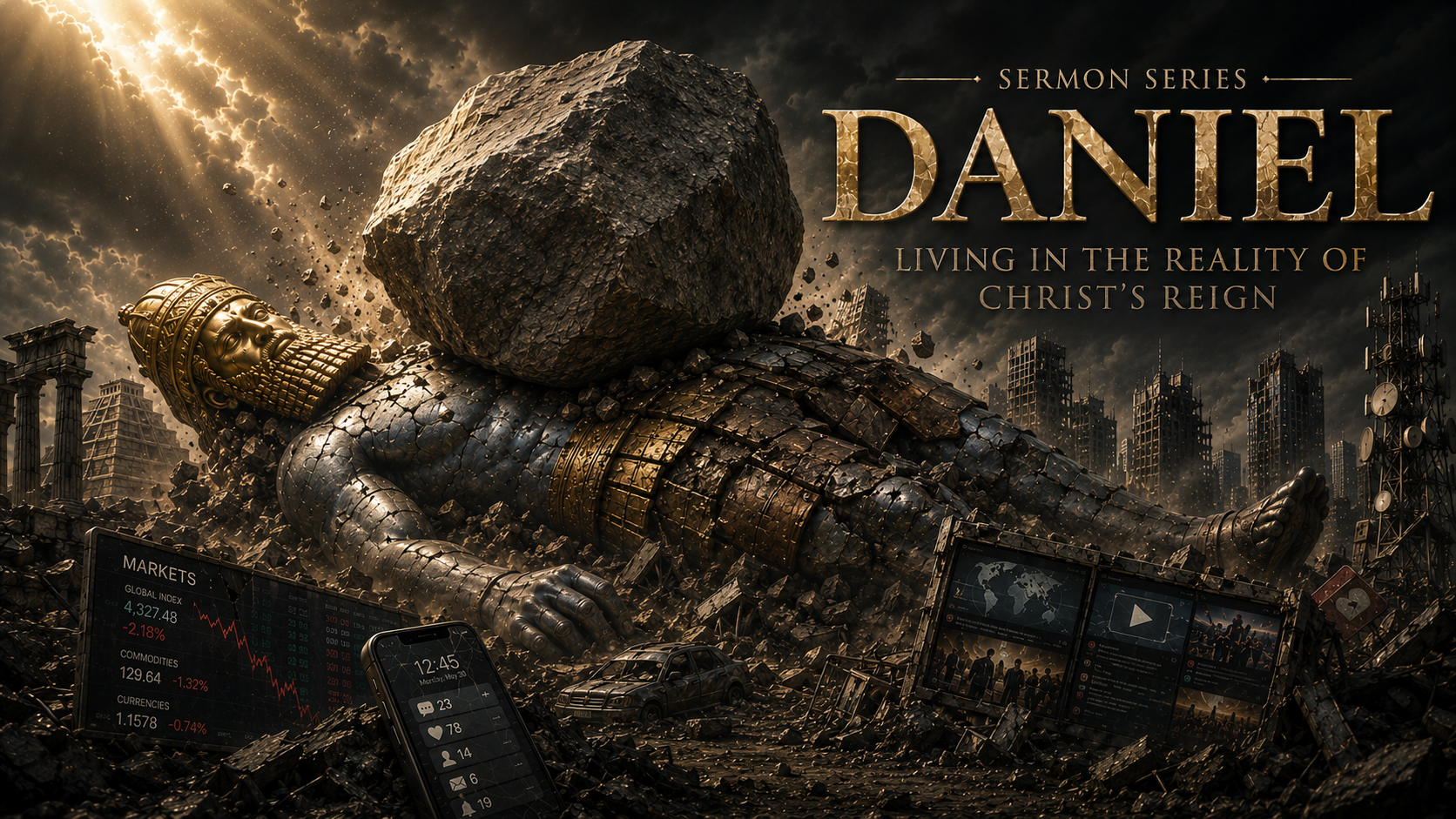
In verses 31-35 we see how every kingdom of humanity is temporary. The dream is revealed as a great image or statue of a man. This statue had a head of gold, a chest of silver, waist and thighs of bronze, iron legs, and feet made of a mixture of iron and clay. Notice the progression. It begins with dazzling gold and decreases in preciousness until finally we reach iron mixed with brittle clay. The picture here is that great kingdoms are eventually replaced, until the strongest one can’t even hold itself together. Every earthly kingdom is temporary and will eventually crumble. Why do we work tirelessly to build up our 401(k), our possessions, our experiences, knowing full well that all of this is just temporary and everything eventually will be turned to dust? I think we are longing for something that is lasting, something eternal.
Yet, in verses 39-43 we are reminded that history proves that humanity's kingdoms will always be brought to an end. Daniel tells Nebuchadnezzar that after his kingdom of Babylon (gold) would come another kingdom, traditionally understood as the Medo-Persian Empire (silver). In 539 BC, Babylon fell to the Medes and Persians. But their kingdom didn't last either. About two hundred years later, Alexander the Great conquered the Persian Empire, establishing the Greek Empire represented by the bronze. And after Alexander's death, his kingdom was divided among his successors and eventually gave way to Rome, the fourth kingdom, strong as iron, crushing the kingdoms before it. Yet even mighty Rome would not remain forever. Like the feet of iron mixed with clay, it possessed tremendous strength but could not hold together forever. Kingdoms rise and kingdoms fall. Babylon, Persia, Greece, Rome—they all looked powerful in their day, and every one of them came to an end. History proves again and again that no human kingdom will last forever.
So why don't we learn from this? Why do we keep seeking to build our own kingdoms?
I think part of the answer is that we long for something that lasts. We don't want to be temporary. We don't want what we love to disappear. We want security. We want permanence. We want something that death and decay cannot take away from us.
And that longing isn't wrong. We were made for eternity. The problem is where we look for it. Instead of receiving the eternal kingdom that God establishes, we grasp for permanence by trying to build and preserve kingdoms of our own.
And when those kingdoms are threatened, we grasp for control. Maybe we hide from what is happening. Maybe we're paralyzed by fear. Maybe we throw ourselves into trying to stop it. That doesn't mean we shouldn't act faithfully in the world. Daniel certainly did. But Daniel knew something we so easily forget: he wasn't the King. He didn't have to control history because his God did.
And we need to remember the same thing. Every human empire, whether ancient Babylon or data centers spread throughout the country, will end the exact same way: crushed into fine chaff, blown away by the wind, gone without a trace.
You don't have to build something that lasts forever. Why? Because…
God establishes his eternal kingdom through Jesus, the rejected and risen cornerstone
Jesus lived as the perfectly faithful Son under his Father's reign. Where we rebel against God's rule and try to establish kingdoms of our own, Jesus perfectly submitted to his Father, faithfully obeying him even unto death.
Nebuchadnezzar used his power to kill others in order to preserve his kingdom. Jesus, who already possesses all dominion, gave his own life to bring his people into his kingdom—a kingdom in which he is uniting all things in heaven and earth under his gracious reign.
In verses 35b, 44-45, we see how God will establish his eternal, all-encompassing kingdom—represented by a stone cut out without the help of mere human hands. What does this mean? This isn't a kingdom built by humanity. God himself establishes this kingdom. And as the rest of Scripture shows us, we know how God established it: not through the hands of another earthly king, but ultimately through the pierced hands of the God-man, Jesus Christ.
And as we will see later in Daniel, this everlasting kingdom belongs to the Son of Man. It is through Jesus Christ that God's kingdom comes and ultimately fills the earth.
In Matthew 21:33-46 with Acts 4:10–12 we see that Jesus is the rejected and risen cornerstone. Here Jesus tells the parable of the tenants who refuse to give the owner the fruit of his land. After the tenants wounded and killed others he sent, the owner sends his beloved son, and what do they do to him? They reject and kill him. And immediately afterward, Jesus interprets Psalm 118: “The stone that the builders rejected has become the cornerstone.” Jesus is the rejected Son and the rejected stone. And notice that Jesus connects this directly to the kingdom of God. The rejected stone will become the cornerstone, and those who oppose him will ultimately be crushed by him. And Peter makes the connection explicit in Acts 4: the Jesus whom they crucified, God raised from the dead; he is the stone the builders rejected who has become the cornerstone.
And that's exactly what happens. The religious leaders reject Jesus. Rome crucifies him. But the rejected stone doesn't remain dead. God raises him from the dead and exalts him to his right hand, where he now reigns as King, saving everyone who trusts in him and ultimately crushing every kingdom that opposes his gracious and sovereign rule.
On the cross, Jesus bore the judgment our rebellion against God's kingdom deserves. He died for kingdom-builders like us. And God raised the rejected King from the dead and exalted him to his right hand, where he reigns and pours out his Spirit upon his people.
You don't have to build something that lasts forever. In Christ, you receive something that lasts forever.
By the Spirit, we get to receive and live for God’s eternal kingdom rather than building our own
Living in the reality that God dwells with us by his Spirit frees us not only to receive his eternal kingdom, but to live for it. We don't have to stick our heads in the ground, be paralyzed by fear, or be consumed with gaining control. We are freed to live for the One who is our Father and loves us eternally.
God's people live for God's eternal kingdom (vv. 27-30, 36-38, 45b): Daniel refuses to present himself as the source of wisdom and instead points Nebuchadnezzar to the God who reveals mysteries, gives kings their kingdoms, and determines what will come to pass. Like Daniel, by the Spirit, instead of taking the honor and glory for ourselves, we honor God and make our lives about God's eternal kingdom.
As part of God's spiritual house, we seek to be his building (vv. 47; 1 Peter 2:4-12): As Nebuchadnezzar, representing the world, praises God as he truly is, the God of gods and Lord of kings, so, as we honor God by the Spirit, some in the world will come to honor him. As those chosen by God to be his possession and built upon Christ, the living cornerstone, we proclaim the excellencies of him who called us out of darkness into his marvelous light, living honorable lives and doing good so that others may glorify God on the day of his visitation, when his kingdom comes in its fullness.
But how does knowing that God's kingdom will crush all other kingdoms and fill the earth help with my anxieties?
When the world seems unmanageable and unstable and I find myself afraid, like when AI seems to be moving in a dangerous direction and creating an empire beyond our control, instead of crumbling in fear or waging an internet war against it, the Spirit reminds me that every earthly kingdom will eventually be crushed and come to nothing. And so the Spirit of adoption cries out in me, “Abba! Father!” I go to my Father in prayer as Jesus taught us, thanking him and seeking his kingdom first, praying, “Father, your kingdom come, your will be done,” and longing for the day when all things in heaven and earth are united in Christ.
When I find myself overwhelmed by increasing prices and am tempted to preserve my own little kingdom by working an unreasonable number of hours for overtime or a promotion, the Spirit reminds me that I do not live by bread alone, but by every word that comes from the mouth of God, and that I am not to be anxious about tomorrow. My Father knows what I need. So instead of grasping for control, I seek him in prayer, asking for provision and wisdom to know how much I should work. Then, after praying and seeking wisdom from my brothers and sisters in the church, I make my decision trusting that my Father is in charge and seeking first his kingdom rather than my own.
Every kingdom we build becomes chaff.
And maybe AI is simply humanity's latest statue—another attempt to build something that will secure our future and give us control. Nebuchadnezzar's statue was gold and iron; ours may be silicon and algorithms. But every kingdom we build has feet of clay. None of them can outlast the Stone.
But there is one kingdom that will never become chaff. There is one King who will never be replaced. And the incredible good news of Christianity is that this King doesn't merely invite us to live under his rule. Through his death and resurrection, he brings us into his family and makes us co-heirs of his kingdom.
So you don't have to build something that lasts forever. In Christ, you receive something that lasts forever.
And if you don't know this King, his kingdom is offered to you today. Turn from trying to build a life that will last and put your trust in Jesus Christ, the rejected and risen King. In him, you can be forgiven, brought into God's family, and receive a kingdom that will never end.
The world is rapidly changing. God is in control. And in Christ, you belong to the King whose kingdom will never end. In him, by the Spirit, we are co-heirs of that kingdom, all to the praise and glory of the Father.
other sermons in this series
Nov 15
2026
The Invisible Battle
Preacher: Rev. James Pavlic Scripture: Daniel 10:1– 11:1 Series: Daniel: Living in the Reality of Christ's Reign
Nov 8
2026
God's Covenant Faithfulness
Preacher: James Pavlic Scripture: Daniel 9:20–27 Series: Daniel: Living in the Reality of Christ's Reign
Nov 1
2026
Living in Dependent Faithfulness
Preacher: Rev. James Pavlic Scripture: Daniel 9:1–19 Series: Daniel: Living in the Reality of Christ's Reign